By Alyssa Lawhorn
Enslaved domestic laborers played strenuous roles in the management and development of Great American Treasures (GAT) sites across America. Due to their intersectional identities as Black women, enslavers expected enslaved women to not only complete the tasks assigned to them but also fulfill additional responsibilities which often took the form of domestic labor. Domestic labor includes assignments that are traditionally done within the home such as cooking, childcare, and cleaning.
The belief that that men and women must be separated in fields of labor due to their gender was not applied to enslaved men and women. Enslavers believed enslaved women should not only work inside but also outside and perform tasks that were traditionally assigned to both women and men. At the conclusion of the day, enslavers desired for enslaved women to continue completing domestic tasks within the realm of the home despite the thorough day of labor they had already completed. The concept of domestic labor resulted in gender becoming a vital aspect of the economy of slavery as enslaved women’s intersectional identity resulted in additional forced labor.
Dumbarton House
In 1804 Joseph Nourse acquired Dumbarton House, an impressive eight-acre property built in 1799 in Washington, DC. The land surrounding Dumbarton House would have also included an icehouse, barn, stable, combined dairy and smokehouse, and quarters. Enslaved, indentured, and free servants resided in these quarters as they lived and worked on the property. One of these enslaved servants was Dinah, a cook enslaved by the Nourse family.
The Nourse household enslaved Dinah for at least 25 years as she is first recorded in a 1785 letter in which Joseph Nourse states “I wish Dinah may be sent along with little Bacchus.” The Nourse household also enslaved Bacchus, a young male. This letter reveals that the Nourse family likely enslaved Bacchus when he was a young man, and Dinah often took on the role of his caretaker during his adolescence. This expectation reveals that the Nourse family likely forced Dinah to take on a motherly role and in turn perform domestic labor as she took care of Bacchus when he was a child. This further highlight that Dinah’s enslavers mandated her to perform many forms of domestic labor which were beyond the typical tasks assigned to a cook. The scope of Dinah’s labor was widened due to her intersectional identity as an enslaved Black woman as the Nourse family not only expected Dinah to complete her designated job as a cook but additional duties including childcare which can be classified as domestic labor.
Dinah also performed domestic labor in the form of cooking. On August 2, 1804, Joseph Nourse sent a letter to Maria Nourse in which he stated, “Richard came down yesterday with a bag of apples which Dinah is pairing for to be dined.” Recipes using apples featured in cookbooks from the late 18th and early 19th century include a buttered apple pie, apple pudding, and apple tarts. Any of these dishes could have been prepared by Dinah and served to the Nourse family. A select number of Dinah’s meals were listed in a letter sent on August 5, 1804 sent from Joseph Nourse to Maria Nourse, “Fran has supplied the table daily with cabbage, potatoes, occasionally corn, 2 eggs. Dinah with fried bacon, an apple dumpling, or a rice pudding.” The Nourse family also enslaved Fran as a cook. In addition to cooking Fran worked in the garden and shopped at nearby markets for ingredients.
Dinah’s tasks as a cook and the additional duties assigned to her due to her identity within the Nourse home reveal the role of domestic labor at Dumbarton House. Dinah was not only expected to execute the tasks within the “cook” title but also complete additional jobs including watching over the children who were enslaved by the Nourse family. Similarly, the belief held by Joseph Nourse in the 1804 letter that Dinah will be able to prepare meals with any ingredients presented to her demonstrates the high expectations held on Dinah and the impact of her identity as a Black woman on the tasks involuntarily placed upon her.
To learn more about Dumbarton House and Dinah, visit dumbartonhouse.org
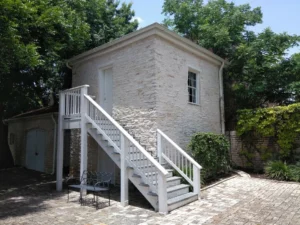
Neill-Cochran House Museum Slave Quarters, Photo by Tara Dudley
Neill-Cochran House Museum
The Neill-Cochran House Museum in Austin, Texas has made great efforts to reckon with the site’s history of enslavement, including researching the many enslaved and free domestic servants who lived and worked at the site. The Slave Quarters at the Neill-Cochran House Museum is the only slave dwelling within the borders of Austin’s original townsite that is both intact and open to the public. Reckoning with the Past: The Untold Story of Race in Austin showcases the lives, stories, and impact of the enslaved and free people who once lived and labored at the Neill-Cochran House site. This project which included restoration to the Slave Quarters and implementation of a new interpretive plan allows visitors to understand the city and site’s complete history.
Prior to the Civil War, the Neill-Cochran House served as a boarding school for the blind from 1856 to 1857. The School for the Blind “leased” several enslaved people from their enslavers to work and live on the property. Mrs. Henrietta Eggleston enslaved a woman and her 8-year-old daughter and then leased both of them to the school for $150 a year. The tasks completed by the woman and her young daughter are unknown. Enslavement resulted in distinctive relationships between mother and child as a constant sense of fear that the child could be sold or abused troubled the mothers of enslaved children. Additionally, the intimate nature of domestic labor resulted in enslaved women being called to work at all hours of the day. As enslavers demanded the completion of time-consuming tasks, enslaved women continued to lose time caring for their children and strengthening the mother-child bond. Enslavement and the demands of domestic labor resulted in enslaved women facing additional challenges as they navigated motherhood, these pressures were likely felt by the woman and child leased to the School for the Blind.
The Neill-Cochran House Museum has made several initiatives to highlight the lives of all enslaved and free laborers that lived and worked at the site. The Give Us This Day mural project by artist Fidencio Duran connects the inside of the main house with the surrounding areas. While at many historic sites, the story of the family who lived at the home is told inside of the home and the story of the enslaved is told outside, the Neill-Cochran House Museum departs from this practice. By connecting the primary house and surrounding buildings, the site is shows the ways in which the lives of everyone who lived and labored at the Neill-Cochran House were connected. Three murals have been created by Duran that show enslaved and free laborers’ daily assignments including laundry, gardening, and more. The completed murals will be installed at the site in early 2025.
To learn more about the Neill-Cochran House Museum and the Slave Quarters Project visit www.nchmuseum.org
Conclusion
Enslaved domestic laborers performed an abundance of forced labor within the realm of the home in addition to their previously assigned duties due to their identities as Black women. The close proximity of enslaved domestic laborers to their enslavers placed them in a position to wrongfully receive additional abuse, violence, and work-related duties. Remembering the lives of domestic laborers at GAT sites across America is an important aspect of understanding the complete histories of these historic homes. Through restoration projects, new interpretative plans, and expanded guided tours, the history of enslavement at Great American Treasures sites is continuing to be memorialized and reckoned with.